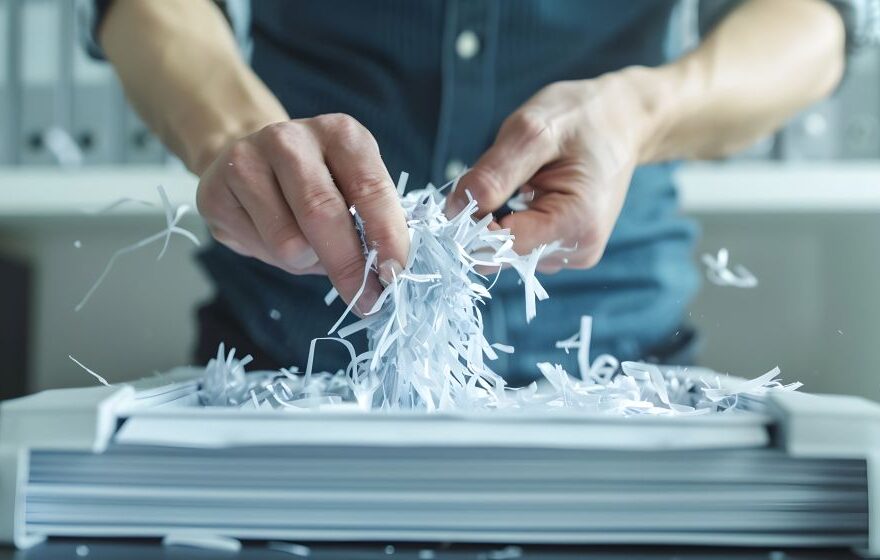
A shredding company in Singapore might seem like a mundane service, a practical necessity in the machinery of modern commerce, yet consider what these operations really represent. In an age where information flows like light through fibre optic cables, where data crosses oceans in milliseconds, we sometimes forget that knowledge still exists in physical form. Paper documents, those ancient repositories of human thought and transaction, continue to accumulate in offices across this island nation. And when their usefulness expires, when they must be destroyed, the method matters more than most people imagine.
The Physics of Information Destruction
There is something almost poetic about the mechanics of document shredding. A sheet of paper, that thin slice of processed wood pulp, contains patterns of ink that represent agreements, strategies, personal details, and secrets. The shredder transforms this ordered information into chaos, cutting and cross-cutting until the original structure becomes irrecoverable. It is entropy in action, the second law of thermodynamics applied to information security.
Singapore’s Personal Data Protection Commission understands this principle well. In their advisory guidelines, they note that organisations must “cease to retain documents containing personal data, or remove the means by which the personal data can be associated with particular individuals” when retention is no longer necessary. Shredding represents one of the most reliable means of achieving this irreversible dissociation.
The technology has evolved considerably from early strip-cut shredders that produced long ribbons of paper, easily reassembled by patient adversaries. Modern cross-cut and micro-cut shredders reduce documents to confetti-sized particles, some as small as 4 by 10 millimetres. At such dimensions, reconstruction becomes practically impossible, a jigsaw puzzle with millions of pieces and no picture to guide assembly.
Why Organisations Turn to Professional Services
One might reasonably ask why organisations engage professional shredding company in singapore rather than simply purchasing their own equipment. The answer reveals much about the complexity hidden beneath seemingly simple tasks.
Consider first the scale. A single office worker might generate several kilograms of confidential waste weekly. Multiply this across an organisation of hundreds or thousands, and the volume becomes substantial. Industrial shredders capable of processing such quantities require significant capital investment, regular maintenance, and dedicated operators.
Then there is the security chain. When employees shred documents themselves, gaps appear in the custody trail. Papers sit in bins awaiting destruction, creating windows of vulnerability. Mobile shredding services that operate on-site or secure collection systems that maintain continuous custody address these weaknesses.
The considerations extend beyond mere practicality:
-
Compliance documentation
Professional services provide certificates of destruction, critical evidence during audits or regulatory inquiries
-
Specialised capabilities
Different materials require different approaches; hard drives, optical media, and identification cards demand equipment beyond standard paper shredders
-
Environmental responsibility
Licensed shredding operations channel destroyed materials to recycling facilities, closing the loop on paper consumption
-
Opportunity cost
Employee time spent managing document destruction represents time diverted from productive work
The Ecology of Information
We live in what might be called an information ecosystem, where data flows through various media, accumulating, transforming, and eventually requiring disposal. In Singapore, a city-state that has built its prosperity partly on information management and financial services, this ecosystem proves particularly dense and complex.
The National Environment Agency’s waste management framework recognises paper as a key recyclable material. After confidential shredding, the resulting paper particles typically flow to recycling mills where they become raw material for new paper products. What began as a confidential contract or sensitive correspondence transforms into cardboard boxes or newsprint. The information dies; the material lives on.
This cyclical process mirrors patterns found throughout nature, where nothing truly disappears but merely changes form. The shredding companies in Singapore that understand this broader context contribute not merely to data security but to resource conservation and environmental stewardship.
Choosing Wisely in a Complex Market
The decision to engage a shredding service provider requires consideration of factors that extend beyond price. Security certifications indicate whether a provider adheres to international standards for information destruction. ISO 21964, for instance, specifies requirements for shredding and disposal services.
Location matters as well. On-site shredding provides visual confirmation of destruction but may not suit all organisational needs or security protocols. Off-site services require trust but often prove more economical for larger volumes.
The frequency of service must align with document generation rates and security requirements. Some organisations require daily collection; others manage with monthly visits. This rhythm of destruction becomes part of operational planning, another cycle in the life of an organisation.
The Larger Context
When we step back and consider the role of document shredding in modern society, we glimpse something profound about our relationship with information. We create knowledge, we store it, we share it, and eventually we must destroy it. This lifecycle reflects human mortality itself, the impermanence that characterises all things in our universe.
Singapore’s approach to data protection and document destruction represents a mature understanding of these dynamics. In a nation where trust in institutions matters enormously, where financial services and technology sectors drive economic growth, the proper handling of information from creation through destruction proves foundational.
The humble shredder, then, becomes more than a machine. It represents our acknowledgment that information, like all things, must eventually return to chaos. That in the careful destruction of documents, we protect not merely data but trust, reputation, and the social fabric that holds our complex societies together.
A Final Reflection
As technology advances and electronic storage increasingly dominates, one might predict the obsolescence of paper shredding. Yet paper persists, stubbornly physical in our increasingly virtual world. For as long as documents exist in tangible form, their destruction will require thoughtful processes and reliable partners. The choice of a shredding company in singapore becomes, in this light, not merely a procurement decision but an investment in organisational integrity and environmental responsibility.